https://www.youtube.com/watch?v=RaMRxXYd69s
If you kill the leader of an entire religion, and start a war of aggression during a country's holiest month—the equivalent of being attacked in the West right before Christmas—you better be damn sure you have a swift way to victory.
With every day this war drags on, the pain on the US and its regional allies—including Isreal, the primary reason for the war—increases. And Iran knows this.
Professor Marandi tells me that Iran has been preparing for this type of scenario for decades. There are reasons why all their important military infrastructure is deep under ground. Listen to Dr. Marandi, Professor at the University of Tehran explaining what it means to be in the city of attack and how the Iranians are reacting to the US' largest assault on the region and on International Law.
There are very serious laws of war. We and Israel are commiting war crimes. We are the terrorists today, not Iran. This is being done in our name, and we too may experience the consequences. You are not allowed to attack civilian targets, period. It is a crime and those who select and bomb those targets deserve a court martial. Meryl Nass Mar 4
(h/t to Mark Wauck for these 2 graphics)
Dear President Trumpty-Dumpty:
What did you expect? You have put our country into a terrible place. You are killing wantonly, or with deliberate vengeance attacking the most vulnerable in schools and hospitals. Did you think the Iranians would walk away with their tail between their legs? They will get their revenge instead.
You have betrayed your own country to share in Israel’s gross criminality, and you cannot even provide a convincing reason why this had to happen. You have betrayed our allies in the Gulf. You have caused terrible damage to Iran—for what? To create a generation of haters and terrorists? You will cost Europe badly.
Stop preening about our military superiority. We are about to see the limits of it. Stop your ceaseless lying.
All the king’s horses and all the king’s men won’t be able to put your presidency back together again. You will leave a legacy of ashes.
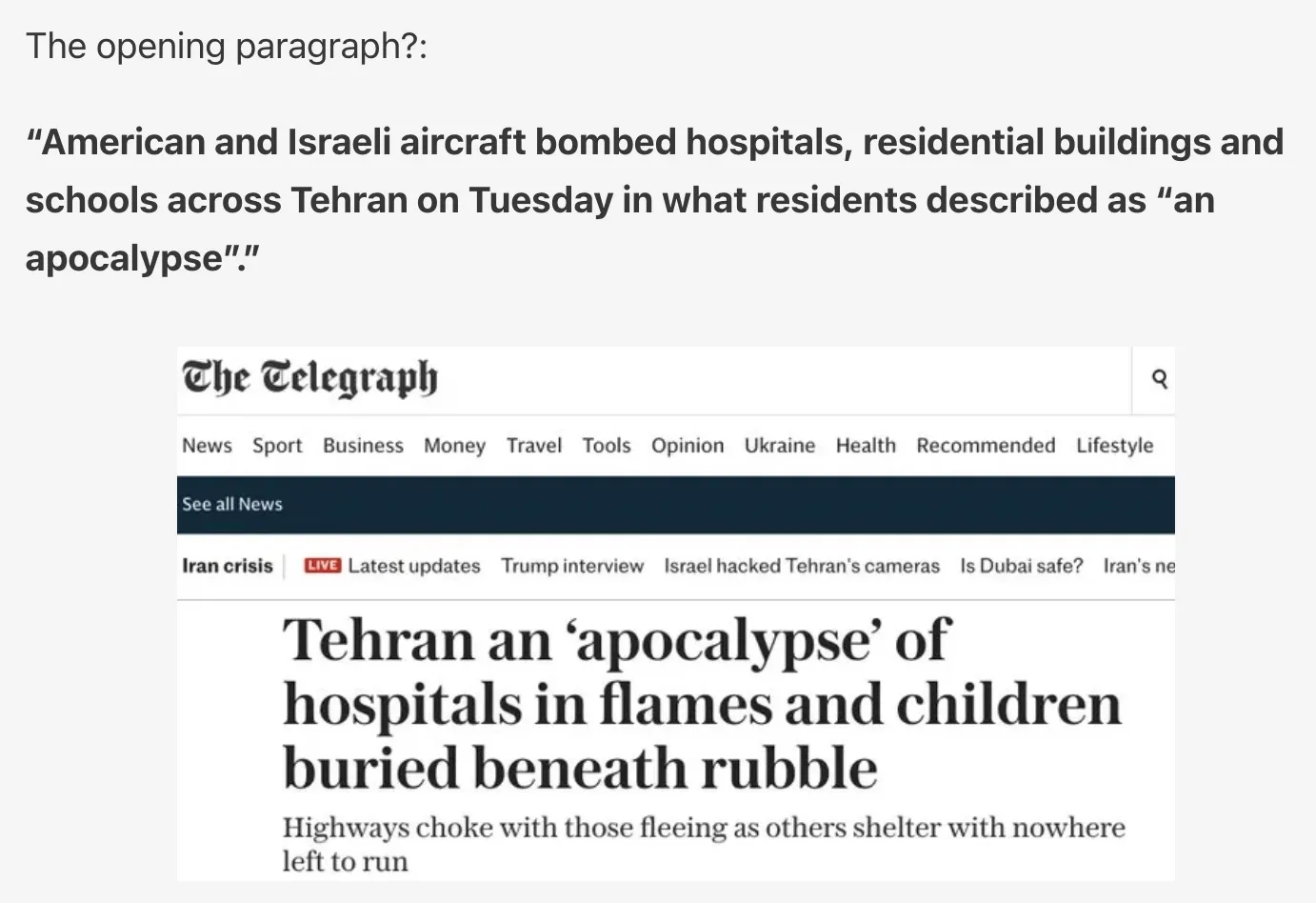
The conservative, high quality British newspaper, The Telegraph, told us the following today:
 https://www.icrc.org/en/document/FAQ-rules-of-war-ihl
International humanitarian law: what are we talking about?
International humanitarian law (IHL) is a set of rules that seeks, for humanitarian reasons, to limit the effects of armed conflict.
It protects persons who do not, or no longer, take part in the fighting (including civilians, medics, aid workers, wounded, sick and shipwrecked troops, prisoners of war or other detainees), and imposes limits on the means and methods of warfare (for instance, the use of certain weapons).
IHL is also known as ‘the law of war’ or ‘the law of armed conflict’. IHL is made up of treaties (the Geneva Conventions and their Additional Protocols are the main ones) and customary international law.
https://watchlist.org/publications/what-does-international-law-say-about-attacks-on-schools-and-hospitals/
What does humanitarian law say about attacks on schools and hospitals?
The Geneva Conventions of 1949 and their Optional Protocols of 1977 (the main treaties of International Humanitarian Law – IHL) set a range of minimum standards for the conduct of hostilities. They are based upon the fundamental principle of distinction between civilians and other protected persons, on the one hand, and those who take part in hostilities (combatants for short).
The term “civilian” refers to individuals or objects (e.g., premises) that do not have a direct role in hostilities (See Rule 5 and Rule 9 of the Study on customary international law by the International Committee of the Red Cross – ICRC). An attack against a civilian person or object is therefore generally a violation of IHL and may constitute a war crime. A person or object can however lose its civilian status if it starts making an effective contribution to military action. It would then become a legitimate military objective (and hence a target) (See Rule 10 of the Study on customary international law by the ICRC). This determination must however be unequivocal: when in doubt as to whether a school or hospital has become a military objective, there is a presumption that it retains its civilian status.
Even attacks against legitimate military targets must, however, follow two additional principles: 1) the principle of proportionality – whereby an attack that would cause incidental loss of civilian life, injury to civilians, damage to civilian objects, or a combination thereof, which would be excessive in relation to the concrete and direct military advantage anticipated, is prohibited (See Rule 14 of the Study on customary international law by the ICRC) – and 2) the principle of precaution in attack – which states that constant care must be taken to spare the civilian population, civilians and civilian objects. All feasible precautions must be taken to avoid, and in any event to minimize, incidental loss of civilian life, injury to civilians and damage to civilian objects (See Rule 15 of the Study on customary international law by the ICRC).