The Iran Conflict Enters a Dangerous New Phase $200 Billion and Still No Plan Breaking Cuba’s Blockade
Wishing you a relaxing weekend.
The Duran Team
The Iran Conflict Enters a Dangerous New Phase
The past 48 hours are being cast as a decisive inflection point in the Iran conflict, following an Israeli strike that reportedly killed senior Iranian figure Ali Larijani alongside civilians. What followed looks less like retaliation and more like acceleration. Strikes on the South Pars gas field grabbed headlines, but the hit on the Bushehr nuclear power plant - housing Russian technicians - has drawn quieter concern despite its far greater risks. Moscow’s irritation over the apparent lack of warning adds another volatile layer. Both targets are civilian infrastructure, and whatever ambiguity remains around damage or attribution does little to soften the reality: escalation is no longer incremental.
Public messaging from Washington has only thickened the fog. Official denials of involvement sit awkwardly alongside reports suggesting prior awareness. Donald Trump has managed to both distance the United States and threaten sweeping retaliation if Iran targets regional energy assets. Tehran, for its part, appears unimpressed. Retaliatory strikes have already reached energy facilities in Qatar and Saudi Arabia, with possible spillover into Kuwait, while shipping disruptions in the Persian Gulf signal a widening conflict. Markets, initially sluggish, are beginning to react - energy prices climbing, financial markets dipping, and central banks hesitating between inflation fears and recession risks.
The deeper concern is structural. Gulf energy flows - especially through the Strait of Hormuz - are not just regional lifelines but pillars of the global financial system. Since the 1970s, oil’s pricing in U.S. dollars has anchored global demand for the currency. Sustained disruption now raises uncomfortable questions about that foundation. The assumption that Iran could be quickly weakened or coerced appears increasingly detached from reality. Instead, Tehran has absorbed early blows, maintained internal control, and escalated outward, turning what was expected to be a short campaign into something far messier.
There is little sign of a brake. Additional U.S. troop movements and ballooning cost projections hint at a familiar pattern: expanding commitments without a clear end state. Comparisons to past military entanglements are becoming harder to dismiss. Behind the scenes, Russia may be preparing material support, while China’s potential involvement lingers as an unspoken multiplier. Meanwhile, Europe watches, largely inert, as energy vulnerability grows. Parallel conflicts - from Ukraine to the Gulf - are no longer separate crises but overlapping pressure points. The trajectory is not decisive victory, but prolonged instability - with escalation no longer a risk, but the operating logic.
https://www.youtube.com/watch?v=_H0lhMUoq0s
Daily Mail An alleged Iranian spy has been arrested after being accused of trying to enter Britain's Faslane nuclear naval base.
The 34-year-old suspect, accompanied by a female, 31, also reportedly Iranian, was in a vehicle when approaching a gate at HM Naval Base Clyde in Scotland.
The pair lacked the right passes to enter and were turned away, it has been reported - before being detained after 'acting suspiciously in the vicinity'.
The naval base is the Royal Navy's headquarters in Scotland and is home to Britain's nuclear submarines including the Vanguard vessels armed with Trident missiles.
The arrests come as Iran's foreign minister warned the UK it sees its choice to let the US use British bases as 'participation in aggression' in a phone call with Foreign Secretary Yvette Cooper.
Iranian foreign minister Abbas Araghchi criticised what he called the 'negative and biased approach of Britain' towards the US-Israeli military action against Iran, as well as the UK's decision to provide military bases for the US to use.
Sir Keir Starmer has granted the US permission for 'defensive' action against Iranian missile sites from RAF Fairford in Gloucestershire and Diego Garcia in the Indian Ocean.
Commenting on the Faslane arrests, a Police Scotland spokesman said: 'Around 5pm on Thursday, 19 March, 2026, we were made aware of two people attempting to enter HM Naval Base Clyde.
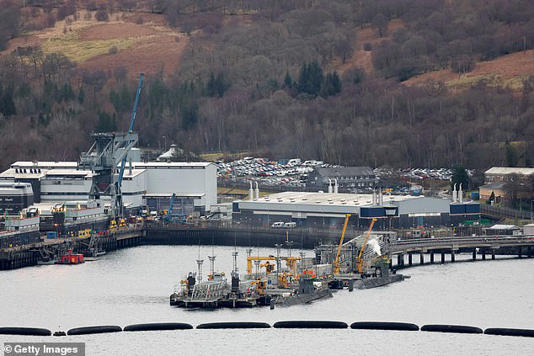
The Faslane naval base is the Royal Navy's headquarters in Scotland and is home to Britain's nuclear submarines including the Vanguard vessels armed with Trident missiles
'A 34-year-old man and 31-year-old woman have been arrested in connection and enquiries are ongoing.'
A Royal Navy spokesman said: 'Police Scotland have arrested two people who unsuccessfully attempted to enter HM Naval Base Clyde on Thursday 19 March.
'As the matter is subject to an ongoing investigation, we will not comment further.'
HM Naval Base Clyde, commonly known as Faslane, is home to four Trident-armed ballistic missile submarines as well as the Navy's seven Astute-class nuclear-powered attack submarines.
The base, 25 miles north-west of Glasgow, hosts submarines powered by nuclear reactors.
A serious nuclear incident took place at the base early last year, it was revealed last August.
There was a Category A event at HMNB Clyde on Gare Loch in Faslane between January and April.
The Ministry of Defence defines a Category A incident as the most serious and those which carry an ‘actual or high potential for radioactive release to the environment’.
The Faslane base is the Royal Navy's headquarters in Scotland and hosts Britain's nuclear submarines including the Vanguard vessels armed with Trident missiles
But the government department insisted the incident at HMNB Clyde did not pose a risk to the public nor result in any radiological impact to the environment.
It was revealed in a written parliamentary answer by defence procurement minister Maria Eagle after she was asked to provide the number of Nuclear Site Event Reports (NSERs) at the Faslane and Coulport bases.
NSERs detail incidents at nuclear facilities and are categorised based on their safety significance and impact.
She disclosed that there had been a category A event at Faslane between January 1 and April 22 as well as two category B, seven category C and four category D incidents.
Ms Eagle added that there were five further events deemed ‘below scale’ and less serious.
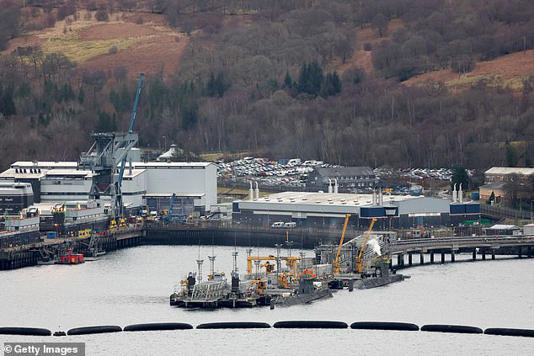
The Faslane base is guarded by Ministry of Defence Police as well as Royal Marine Commandos from the 43 Commando Fleet Protection Group.
The criticism of Britain from Iran came in a post in Farsi on the website Telegram, in which Mr Araghchi said he told Ms Cooper: 'These actions will definitely be considered as participation in aggression and will be recorded in the history of relations between the two countries.
'At the same time, we reserve our inherent right to defend the country’s sovereignty and independence.'
Downing Street defended the UK’s position, with the Prime Minister Sir Keir Starmer's official spokesman saying: 'Our position is very clear. We didn't participate in the initial strikes, and we’re not getting drawn into the wider war.
'We have authorised the US to use our bases for a specific defensive and limited purpose in response to Iran’s continued and outrageous aggression, and we've always said that this is the best way to eliminate the urgent threat and restore a path to diplomacy.'
ED - The UK is not an independent state and our armed forces are under the orders of the US President as part of the Trident treaty, entered into by Mrs Thatcher. It would be better to halt this war on Iran and sue for peace between England and Iran. Before the escalation comes our way any more than it has already. Unfortunately we are trapped in alliance with the US. We can get rid of the Trident nuclear missile alliance, close our alliances, and declare English independence. England's Independence is the policy of the English Democrats.